ServicesDuctless Mini-Splits
Fairfield Ductless Mini-Split Installation
A mini-split warms and cools a room through a slim line set, so no ductwork is needed. We match each indoor head to the room it serves, install it neatly and leave you with quiet, steady comfort through cold winters and hot, dry summers.
Where a Mini-Split Makes Sense
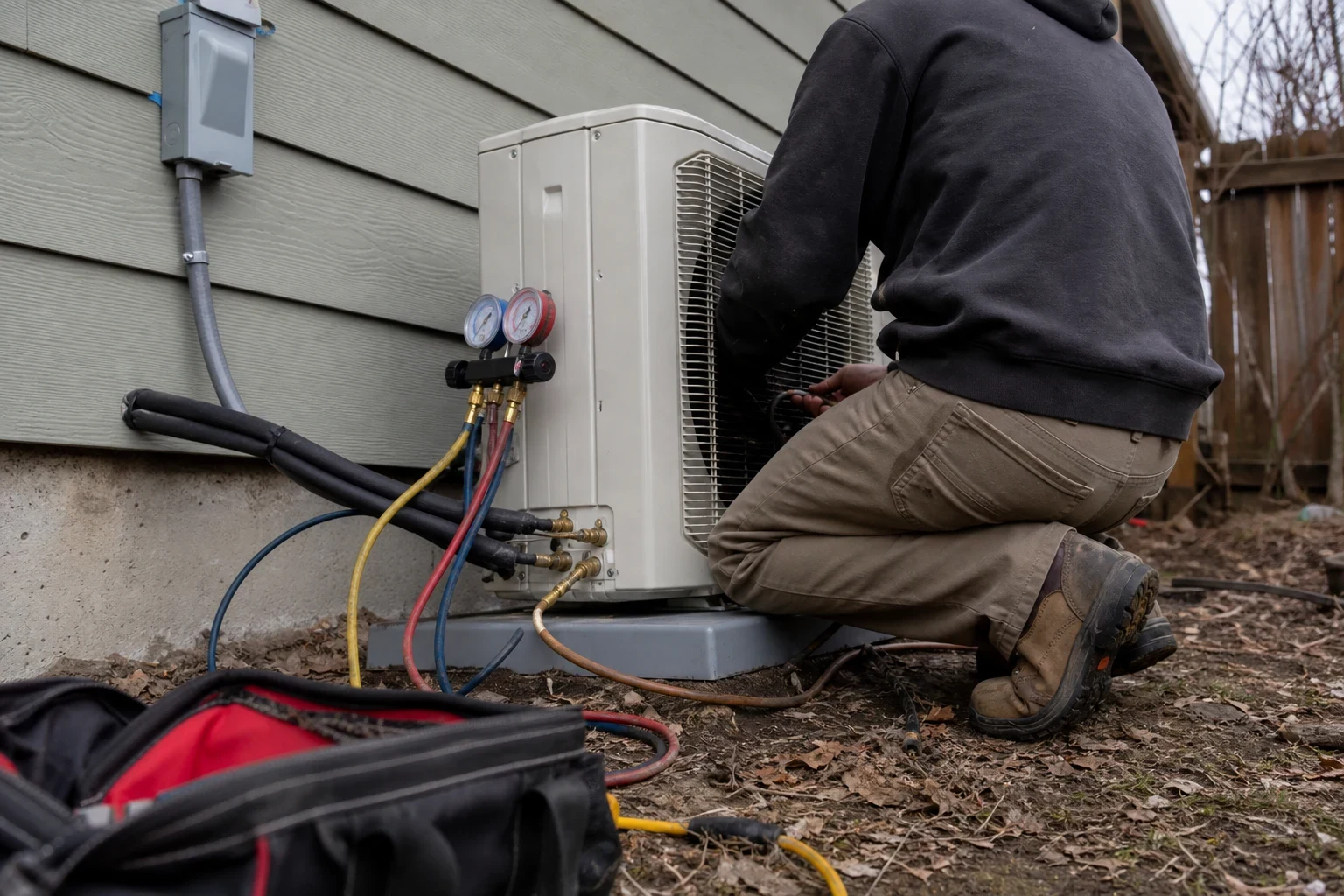
A mini-split connects an outdoor compressor to one or more indoor heads. The refrigerant lines, drain line and power cable all pass through a wall opening roughly three inches wide. Every head has its own controls, so you can keep the bedroom cooler than the living room.
They fit best in spaces ducts never reached or never served well: a garage turned office, a finished basement, an upstairs that overheats in July, or an older house still warmed by baseboard heaters or a wood stove. In rooms like these, a mini-split usually draws much less power than resistance heat.
Not every home needs one. If your ducts are in good shape and only the furnace is worn, we will say so and go over heat pumps or furnace installation with you.
What Your Installation Includes
A room-by-room load check
We measure each room and note window area, insulation and which way it faces. That tells us the capacity each head needs, so nothing short-cycles or struggles.
Cold-climate equipment
Winter nights here drop well below freezing. We recommend outdoor units rated to keep heating at low temperatures, so you are not leaning on backup heat in January.
Careful placement and line routing
We pick head locations for good airflow and a tidy look, then route lines through the shortest clean path. Exterior runs go in a painted line-hide cover rather than bare insulation.
A raised, level outdoor pad
The condenser sits on a stand or wall bracket above the snow line, with room for defrost water to drain and freeze away from walkways.
Permit, vacuum and startup
We pull the electrical permit Washington requires, pull a deep vacuum on the lines and check the charge before startup. Then we walk you through the remote and the settings that matter.
When Going Ductless Could Help
- A room that's always off
- The typical example is a sunroom, addition or room above the garage that runs cold all winter and stuffy all summer.
- Baseboard heat driving up bills
- Baseboard heaters convert each watt into exactly one watt of heat. A heat pump moves heat rather than making it, so it generally costs a good deal less to run.
- Hauling window units each year
- If window units go in every spring and come out every fall, a mini-split cools quietly and keeps the window and view clear.
- Nowhere to run ducts
- Plaster walls, shallow attics and slab floors make ductwork tough in older homes. Going ductless means no walls get opened up.
- Finishing a new space
- Basements, shops with living quarters and new additions are simpler to heat and cool on their own than to connect to the main system.
How the Work Goes
- 1
Free estimate at your home
We look at the rooms, the exterior wall and your electrical panel. You get a written quote before any work begins, with each head, the outdoor unit and the line runs listed.
- 2
Prep and protection
On install day we lay drop cloths, cover furniture near the work and set up a dust shield where we drill.
- 3
Mounting and connection
We hang the wall plates, core the line hole, set the outdoor unit and run power from a dedicated circuit. Most single-zone jobs finish in a day; multi-zone systems can take two.
- 4
Testing and cleanup
We test heating and cooling at each head, confirm the condensate drains, seal the wall penetration and vacuum up. The inspection is scheduled once the work is done.
How a Mini-Split Quote Comes Together
Two things set most of the price: the number of rooms you want served and how much work it takes to reach them. We see the space before quoting, and the written quote breaks out every dollar. Estimates on installations and replacements cost nothing.
- Rooms served
- The simplest system pairs one outdoor unit with one indoor head. Each added room brings another head, extra line set and, often, a larger multi-zone outdoor unit.
- Distance and route of the lines
- Mounting a head on an exterior wall right above the outdoor unit is quick. Routing lines through an attic, around corners or up two stories uses more material and labor.
- Room in the electrical panel
- Many older panels have space for one more circuit. Some need an upgrade first so a heat pump can be added safely.
- Equipment efficiency
- A cold-climate unit costs more on day one and pays it back with smaller winter bills. We walk you through that trade in plain numbers.
- Rebates and tax credits
- A mini-split counts as a heat pump, so it may be eligible for Avista rebates and federal tax credits. We help with the forms for both, and what comes back brings down what you actually spend.
Questions About Mini-Splits
- Can a mini-split handle winter in Fairfield?
- Cold-climate models keep heating into the single digits and lower. Output falls a bit on the very coldest nights, and we size for that. Many owners hold on to a baseboard heater or stove as a backup they seldom need.
- How much noise do they make?
- On low, an indoor head is roughly as loud as quiet talk from the next room, and often softer. The outdoor unit hums, and in winter you may hear a short whoosh when it defrosts.
- What will the indoor units look like?
- Most are thin white units mounted near the top of a wall. Where a wall unit wouldn't suit the room, ceiling cassettes and low floor consoles are available, and we show you each option before you choose.
- What upkeep does it need?
- Take out the washable filters and rinse them every month or two. Outdoors, clear away snow and leaves so air flows through the coil. A yearly professional cleaning of the indoor coil and blower wheel keeps efficiency up, and our maintenance plans include it.
- Will one outdoor unit serve more than one room?
- Yes. A multi-zone condenser can run anywhere from two to five or more heads, each with its own thermostat. When rooms are far apart, two single-zone systems can be the better fit, and we explain why when that applies.
Talk Through Your Rooms With Us
Tell us which spaces are uncomfortable and how your home is heated now. We will come out, look at the walls and panel, and give you a written quote with no pressure to decide that day.